
Icons of the Woods: Comparing the Kephart, Nessmuk, Morakniv, Puukko, and Green River knives.

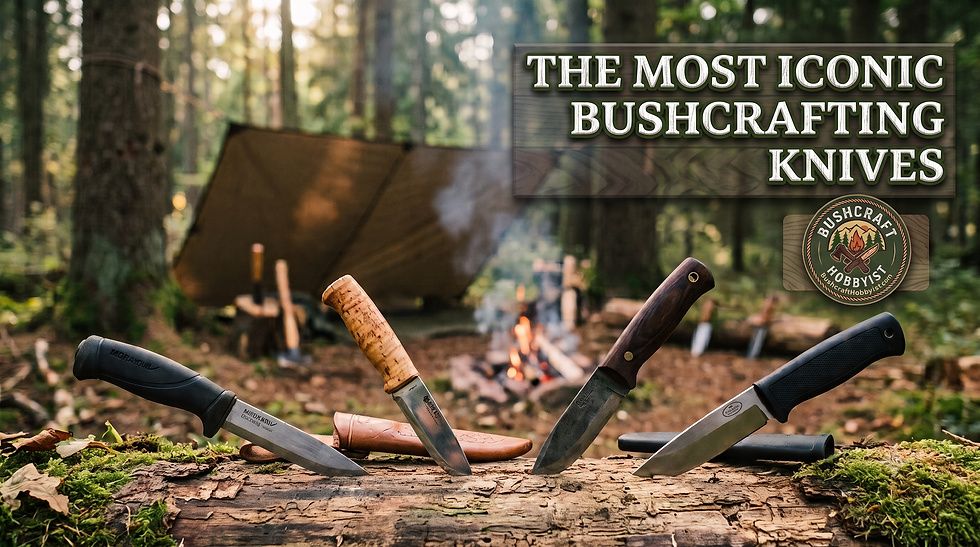
Ask ten bushcrafters what the "perfect" woodcraft knife is, and you will likely start a lively campfire debate. While modern blade steels and tactical designs dominate marketing feeds, traditional bushcraft knives have stood the test of time for a simple reason: they work.
Long before "bushcraft" was a trending keyword, outdoor pioneers, indigenous wilderness travelers, and northern woodsmen relied on simple, efficient blades to survive and thrive.
In this guide, we dive deep into the history, popularity, pros, and cons of four iconic outdoor bladed tools: the Horace Kephart knife, the Nessmuk knife, the Morakniv, and the Scandinavian Puukko.
1. The Horace Kephart Knife: The Father of Modern Bushcraft Blades

History & Popularity
Horace Kephart—celebrated author of Our Southern Highlanders and Camping and Woodcraft (1906)—is widely considered one of the founding fathers of modern camping. Kephart rejected the massive, heavy Bowie knives popular in his era. Instead, he designed a simple, medium-sized belt knife forged by a blacksmith in Colclesser Brothers, Pennsylvania.
His blade featured a 4- to 5-inch spear-point blade, a flat or convex grind, full-tang construction, and simple wooden handle scales. Kephart’s design became the blueprint for what most people recognize today as a standard bushcraft knife.
Pros
Unmatched Versatility: The centered spear-point blade is exceptional for drilling, skinning, carving, and camp kitchen prep.
Balanced Ergonomics: The straight, neutral handle allows for multiple hand grips (forward, reverse, chest-lever) without causing hot spots.
Full-Tang Strength: Built tough enough to handle light batoning and heavy wood processing.
Cons
Jack of All Trades, Master of None: While it does everything well, it doesn't carve as effortlessly as a scandi-grind blade or skin as fast as a swept trailing-point blade.
Aesthetic Simplicity: Some modern users find the basic spear-point shape plain or visually spartan.
2. The Nessmuk Knife: The Ultimate Wilderness Slicer

History & Popularity
George Washington Sears, who wrote under the pen name "Nessmuk" in the late 19th century, was a fragile-bodied adventurer who advocated for ultra-light wilderness travel. In his 1884 classic Woodcraft, he illustrated his famous "trinity" of cutting tools: a double-bit pocket axe, a two-bladed pocket knife, and a custom fixed-blade belt knife.
The Nessmuk knife features a distinct hump on the spine near the tip, a broad blade, and a pronounced sweeping edge. It was intentionally thin and light, designed strictly for slicing, skinning, and preparing game—not for prying or chopping wood.
Pros
Exceptional Skinning & Food Prep: The dramatic curvature ("belly") makes processing game, gutting fish, and slicing meat effortless.
Spoon Carving Advantage: The broad hump near the tip can be used to scoop out wooden spoons and bowls.
Lightweight Efficiency: Designed to be carried all day without weighing down your belt.
Cons
Weak Tip for Drilling: The blunt, swept-back point makes piercing tasks and drilling holes in wood difficult.
Not for Heavy Woodworking: The thin blade geometry isn't suited for heavy batoning or splitting dense hardwoods.
3. The Puukko: The Finnish Wilderness Standard

History & Popularity
Originating in Finland over a thousand years ago, the Puukko is one of the oldest bladed designs still in continuous use. Historically carried by nearly everyone in Nordic regions—from reindeer herders to woodcarvers—it is deeply ingrained in Scandinavian culture.
A traditional Puukko features a short blade (typically 3 to 4 inches), a flat spine, a zero-scandi grind, and a barrel-shaped wooden handle (often curly birch) without a handguard. It is designed primarily as a tool for working wood and processing organic materials.
Pros
Masterful Wood Carver: The true Scandi grind bites into wood with incredible precision, making feather sticks, notches, and deadfalls effortless to craft.
Compact & Lightweight: Exceptionally easy to carry as a neck knife or on a traditional dangling belt sheath.
Comfortable Oval Handle: The smooth, guardless handle allows you to rotate the knife freely in your hand for intricate carving angles.
Cons
Lack of Finger Guard: Requires proper hand technique; slipping forward onto the sharp edge can happen if thrusting recklessly.
Narrow Tip: Intended for wood and game craft, not for heavy prying or twisting forces.
4. The Morakniv: The Modern Utility Powerhouse

History & Popularity
Hailing from the Mora region of Sweden, where knife-making traditions date back to the 17th century, Morakniv transformed traditional Scandinavian design into a mass-production marvel. Combining classic Swedish Scandi blade geometry with modern high-carbon/stainless steels and molded rubberized handles, Mora created the ultimate budget-friendly workhorse.
Models like the Mora Companion and Mora 511 are recommended globally by bushcraft instructors as the premier entry-level knife for students and experts alike.
Pros
Unbeatable Value: Delivers elite wood-carving performance at a fraction of the cost of custom handmade knives.
Easy to Maintain: The true Scandi grind is straightforward to sharpen in the field using flat stones.
Weather Resistant: Modern polymer handles and sheaths thrive in wet, muddy conditions without rot or corrosion issues.
Cons
Partial Tang (Most Models): Standard models use a rat-tail or partial tang, which can fail under extreme abuse like heavy batoning (though models like the Mora Garberg feature full-tang construction).
Utilitarian Looks: Lacks the traditional hand-forged aesthetic and heritage feel of custom leather and wood options.
5. The Dexter-Russell Green River Knife: The Original American Workhorse

History & Popularity
Long before tactical fixed blades or specialized bushcraft steels existed, there was the Green River knife. Manufactured by John Russell in Greenfield, Massachusetts starting in 1834 (and later becoming Dexter-Russell), these blades became the absolute standard for 19th-century American frontiersmen, mountain men, buffalo hunters, and trappers.
During the westward expansion, hundreds of thousands of Green River blades were shipped out past the Missouri River. They were so renowned for their quality and edge retention that the phrase "done up to Green River" became common pioneer slang for doing something thoroughly or driven all the way in. Simple, utilitarian, and hand-forged from high-carbon steel, these knives were built for hard labor, game dressing, and survival in the untamed wilderness.
Pros
Rich American Heritage: Carrying a Green River knife connects you directly to the trade-era history of American mountain men and outdoor pioneers.
Superior Slicing Geometry: The thin, high-carbon blade features a flat grind that slices through food, meat, and hides with incredible ease.
Easy Field Maintenance: Carbon steel takes a razor-sharp edge quickly on natural river stones or field sharpeners, developing a beautiful natural patina over time.
Affordable & Customizable: Available inexpensively as pre-made knives or unfinished blank blades, making them a favorite for DIY bushcrafters who want to fit custom wooden or antler handles.
Cons
Requires Rust Prevention: High-carbon steel will rust quickly if exposed to moisture, wet sheaths, or acidic food without proper oiling and care.
Blade Flex: Thin blade profiles make them incredible slicers, but they are not designed for heavy wood batoning or lateral prying.
Basic Sheaths/Handles: Factory versions usually come with simple wooden scales and require purchasing or crafting a custom leather sheath.
Comparison Matrix
Knife Model | Origin | Primary Strength | Ideal Grind | Tang Style |
Kephart | USA | All-around campsite utility | Convex or Flat | Full Tang |
Nessmuk | USA | Game processing & slicing | Flat or Hollow | Full Tang |
Green River | USA | Frontier hunting, skinning & kitchen prep | Flat | Full Tang |
Puukko | Finland | Fine wood carving & craft | Scandi | Hidden / Stick Tang |
Morakniv | Sweden | High-value, woodcraft workhorse | Scandi | Partial (Full on select models) |
Which One Belongs in Your Kit?
Choose the Kephart if you want one do-it-all knife capable of handling everything from camp cooking to light wood splitting. (See the selection on Amazon)
Choose the Nessmuk if you prioritize hunting, fishing, trail cooking, and game preparation over heavy wood processing. (Check pricing on Amazon)
Choose the Puukko if you appreciate hand-crafted heritage tools and spend most of your campfire time fine-carving trap triggers, spoons, and feather sticks.
Choose the Morakniv if you want a reliable, razor-sharp workhorse that delivers maximum performance without worrying about scuffs or loss.
(See if Amazon has next day delivery)
Choose the Green River Knife if you love living-history outdoor gear and want a razor-sharp, time-tested pioneer slicer that excels at skinning, camp kitchen prep, and field dressing. (Here's the one we've been carrying since Nov 2025)
What is your go-to belt knife on the trail?
Do you prefer a classic Scandi grind or a full-tang spear point? Let us know in the comments below!


Comments